Home ->
Pictures -> Decker Association
Reunion 2005
Decker Family Association 2005 Reunion - New York
Quoted
information from the Summer 2005 Decker Family Association Newsletter
Day 1 - October 6, 2005
Albany & Area
After the long drive from Michigan to Albany, New York
the previous day, the 2005 Decker Family Association reunion officially
kicked off by meeting and touring the First Church of Albany.
"Originally the Dutch Reformed Church, the
congregation dates back to 1642, making it the oldest church in upstate New
York.
"At that time the town was called Rensselaerswyck,
part of the Fort Orange complex. The building we'll tour is the fourth
building for the congregation, and dates ack to 1798. The
pulpit, imported from Holland in 1656, is said to be the oldest pulpit in
America.
"The archives of the church provide invaluable
genealogical information. The college-educated ministers were
meticulous in keeping records of births, deaths, marriages, and baptisms."
This is a very impressive, historic church.
Organs & such were not the style of the early Dutch Reformed churches, but
were added later. Also, the stained glass windows (and many other
enhancements) were made during the early 1900s.
Following our tour and historical background of the
church, we met outside and toured the area of Albany, New York, that was the
site of the original settlement of Beverwyck. Led by Charles T.
Gehring of the New Netherlands Project, the walk pointed out interesting
historical points in the development of Albany, and ended near the
riverfront of the Hudson River.
Just across the river from Albany is the historic site
of (Fort) Crailo. This historic site, currently the location of a
museum, is most famous for being the site where "Yankee Doodle" was written,
on the grounds of this estate. The outside of the house has a number
of "keyhole" type ports handy for using guns to defend the building.
The picture of the Fort was taken inside the museum,
depicting the way Fort Orange looked during the 1600s.
The kitchen, located in the basement of the house,
was a very interesting look into the life within Crailo.
I really enjoyed our tour of the Half Moon. While
it is earlier than the ships used to settle the area in the later 1600s, it
does represent the type of ships used in the day, and very possibly the type
of ship that Jan Broersen reportedly sailed on around 1644.
"The New Netherland Museum operates the Half Moon, a
reproduction ship that Henry Hudson sailed from Holland to the New World in
1609. This plank-by-plank replica was created by the New Netherland
Museum.
"The original Half Moon (Halve Maen) was
commissioned on March 25, 1609, for the Dutch East India Company. She
was a ship of exploration and the spaceship of her age, designed to take a
crew of twenty into unknown and uncharted waters.
"Her captain, Henry Hudson, was already a famous
explorer of Arctic waters when in 1608 he was hired by the Dutch East India
Company to find a Northeast, all-water route to Asia. But only a month
out of port, the Dutch/English crew of his ship was disheartened after their
passage north of Norway was blocked by Arctic ice floes. Many talked
of mutiny.
"After reaching the Maine coast and replacing a
foremast lost in rough storms during her Atlantic crossing, the Half Moon
sailed southward as far as the present day North Carolina Outer Banks.
Then, turning northward, Hudson explored the Delaware Bay before arriving at
the mouth of a wide river. Could this be a passage to the Pacific
Ocean?
"Hudson stopped at points on the New Jersey coast
before sailing the small ship up the river which today bears his name, but
it was soon obvious that it was an inland river, not a westward passage.
Hudson sailed upriver to present-day Albany before returning down river."
After our tour of the Half Moon, I took a picture
of my aunt Jean (Decker) Hanke, an my mom Nora Decker. Later they had
to put up with my driving all over the state of New York, but so far they
were still smiling.
Finally, I also took a picture near this site,
looking up the Hudson River, which was very scenic. This picture is
available in hi-resolution for use as a
wallpaper.
Although not part of the reunion itinerary, as a final
part of our tour of Albany we decided to tour the Albany Rural Cemetery.
There was no real reason for wanting to tour this site, as I had never even
looked at researching this cemetery really. What we found first of
all, was a very interesting (& large) old cemetery.
Of particular interest was the discovery that this is
the burial site of President Chester Arthur. The wreath at his grave
was fresh flowers, with a simple card that read "Mr. President."
Day 2 - October 7, 2005
Kingston & Area
Our first stop of the day was actually across the
river in Columbia County, at the home of the Livingston family called
Clermont. This site held particular interest to me, as my line of
Deckers lived in this area for a couple of generations. Gerrit Decker,
great-grandson of Jan Broerson, was married in Columbia County, and
his children were born there and baptized in the Linlithgo Reformed Church.
His son Myndert Decker is listed on the 1800 census in Columbia County, and
his children were born here. I have a reproduction of the 1798 plat
map of Livingston, Columbia County which lists many people with the name
Decker living around the township (since divided into smaller townships).
Clermont was a home to the Livingston family, one
of several manors in the county, since the late 17th century. Staying
in the family until the 1900s, the manor has all original furnishings that
were owned by the Livingston family. The family still occasionally
holds reunions at the site, and Croquet on the lawn is a favorite past time,
as it was many years ago.
The bottom picture is that of the library, which
was originally added onto the house as a billiard room (evidence of which
can be seen in some areas). The woodwork and craftsmanship are
excellent.
The home itself was burned by the British during
the Revolutionary War, but was soon rebuilt, and later a third floor was
added. For more information see the
Friends of Clermont site.
The plaque is dedicated to Robert R. Livingston, or
"Chancellor Livingston," born 1741, died 1813. Listed are his many
accomplishments:
Recorder of New York, 1773-1775
Member of Continental Congress 1775-77,
1779-81, 1784-85
On committee of five which drafted Declaration
of Independence
Member of Provincial Congress, 1775-77
Chancellor of New York, 1777-1801
Secretary of Foreign Affairs, 1781-83
Minister to France, 1801-04
Negotiator of Louisiana Purchase
Administered oath to George Washington as
first President of United States, 1789
Shared with Robert Fulton invention of the
steamboat and its navigation
Grand Master of Grand Lodge of Free and
Accepted Masons of New York State, 1784-1801
Second stop was Hurley, just outside of Kingston.
After lunch at the Hurley Mountain House we took a walk through old Hurley
with historian Dave Baker.
Jan Broersen,
after living in Kingston during the stockade period, eventually ended up in
this area, being named Magistrate of Horly (Hurley) and Marble (Marbletown)
in 1673.
A light rain did little to hinder the enjoyment of
the walk.
By the time we reached the Kingston Reformed Dutch
Church, the rain had picked up a little bit. Thankfully all of our
outdoor stuff, pretty much, had been completed. Although I had been to
the church before (three years ago) during the winter, this was my first
chance to go inside the church and learn about its architecture and history
in more detail.
Although this isn't the
original structure (built in the mid-1800s), it is on the same site as the
original church (on the corner of the lot) built in the 1600s. The old
graveyard is fascinating, as the graves date back many years, and the names
are very familiar as I look through the family tree. The church
records show two Deckers buried here:
Decker, Joseph - 11/7/1828
Decker, Maritie - 7/6/1776
Although I did not see their graves (many stones
are well worn, and it was raining, after all), just being on this site again
makes me feel very connected to my ancestors. After all, it is near
here where Jan Broerson first lived inside the stockade. (Research by
other members of the family puts his home near across from the corner of
Wall Street and Middle Street - now John Street. If this is true, Wall
Street now being a through street may go through the site of Jan Broerson's
home.)
These plaques within the Kingston Reformed Dutch Church
contain the names of the individuals who were buried in the churchyard on
the site where the current church was built. Their gravestones were
moved to another location in the cemetery with an 'X' marked on the back
identifying them as stones that have been moved.
Although it was raining, I felt compelled to take a few
pictures of gravestones with names that I knew I had seen within the Decker
family tree. I had been here before (January 2002) and took some
pictures, snow & all. The final picture is a new plaque created by
Donna Light, director of the Old Dutch Church Heritage Museum. It
lists those that served in the Revolutionary War that are buried on this
site. Donna gave us a great background of the church and lots of
information within the church museum.
Day 3 - October 8, 2005
The Decker House - Red Mills Road
I had been by this house before, but never inside.
The house has been beautifully restored. Located on the site of a 1694
land patent of 1280 acres near the Shawangunk church, the original home (a
log cabin) on this site was built by Cornelius Janssen Decker (1670/76 -
1702). His son Johannes Cornelius Decker (1696-1742) later built the
current stone house, which served the Decker family for several generations. This is the home that was listed in the book
"Dutch Houses in the Hudson Valley Before 1776," by Helen Wilkinson
Reynolds, 1929, The Holland Society, New York; pages 189-190, listed in the
Stories
section of this site.
Although it was raining steadily on the day of our
visit, the tour of the house was very special Extra pictures outside
were taken quickly, but add to the scenery of the homestead.
The top picture showing the site & surrounding
trees (along with the fall leaves) is also available on this site in high
resolution for use as a
wallpaper.
The inside of the home has been wonderfully restored by
Ms. Bienstock, who served as a wonderful & gracious host during our visit.
The top picture shows the room with large wardrobes, just inside the front
door.
The next three pictures show the room
to the right of the entryway, which served us as an informal dining area
with delicious snacks. The fireplace added to the warmth of the room,
and the shelves in the corner, complete with little statues of farm animals,
completed the informal atmosphere of this room.
Next are two pictures of the more formal dining
area, just to the left of the main entryway, followed by two pictures of the
next room to the left (the far left end of the house), which serves as a
living area, or study. Of particular note is the very old plat map of
Ulster County hanging near the corner.
The final picture in this set is the room down the
small set of stairs to the back of the house, which originally served as a
room for the slaves.
The upstairs portion of the home is complete with two
beds, and lots of old toys. The age of the home can be felt by how
uneven the floor is, but the room is decorated nicely and is still used
today.
We spent the day Saturday, before & after our visit to
the Decker house, at the Shawangunk Church. Behind the church is the
old cemetery, along with newer sections. Being that Deckers were early
settlers of this area, there are a large number of
Decker graves
within the cemetery located here.
During
our visit to the church we enjoyed many great presentations by those
attending the reunion, including information on the DNA study, the location
of the Netherlands where Jan Broerson was from (Husum), a story about Jesse
"the Wanderer" Decker, and a wonderful artifact of what might be called "the
Decker spoon:"
This spoon was shown by Jim Decker at the reunion,
who purchased it out of a lot (auction materials also available) that
contained items owned by a Decker. The spoon dates back as far as the
1500s, but contains some interesting inscriptions on the bottom of the bowl.
The first four letters (hard to determine them all) are not necessarily
related, but underneath these are the letters JJD. On the handle the
letters BKD are scratched. Are these the initials of Jan Jacobsen
Decker and his wife Belytie Kortregt Decker? Only two days before, at
the First Church of Albany, we had heard about the practice of the time of
giving spoons to those who attended funerals, hence only those who were
invited could attend. Could this have something to do with this spoon?
Amazing how much interest one can have in a spoon.
Day 4 - October 9, 2005 (Returning Home)
Sunday morning we left Kingston and began our long,
meandering journey home. And I do mean MEANDERING.
Part of the enjoyment I have on trips like this,
besides taking the occasional out-of-the way route, is to visit some of the
towns, churches, and cemeteries that I keep entering in my family database.
Therefore today I wanted to see such places as Linlithgo, Claverack,
Westerlo, and South Berne - all for reasons I will describe as I mention
each location.
First stop, then, ended up being in Claverack.
I keep seeing baptisms in the family records in Claverack, so I wanted to
see where it is in relation to other towns, and what it looks like. If
I found a church, that would be a bonus. But driving into town with no
real plan ahead of time, you take what you can get.
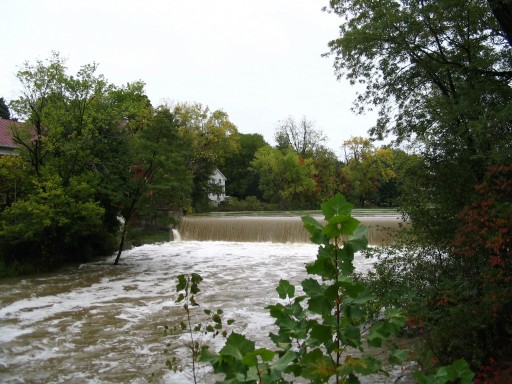
What we got was this mill. The fall colors
were just about right to get some great pictures. This was at the end
of nearly two days of solid rain, causing much flooding in other areas of
New England, so that may have had something to do with the amount of water
flowing over the dam. Having only been there this one time, I may
never know.
I climbed down the embankment next to the bridge to
take the bottom picture, which is my favorite amongst these mill pictures.
It's available in hi-res on my
wallpaper page.
Next up was looking for the site of the original
Linlithgo Reformed Church, the site of many baptisms of Deckers, including
the children of Gerrit Decker, great grandson of Jan Broerson.
Now, this is where confusion sets in. I
understand that the original Linlithgo church eventually ended up being
moved to the town of Livingston. Eventually another church was built
on the site of what was the Linlithgo church, that being the Livingston
church.
So the story goes that that Linlithgo church is in
Livingston, and the Livingston church is in Linlithgo. Following my
county based map of New York, I arrived at the site of what I figured would
be the site of the original Linlithgo church, but it is now called the Mt.
Pleasant Reformed Church. So where was I?
No matter where this is, there were a number of
gravestones with Decker on them. Wandering through the cemetery, I
took a picture of all of them (I think). Someday maybe I'll get time
to look into this a little more and figure out just exactly which cemetery
this is.
After leaving Columbia County, we headed back across the
river and up toward Albany County. First destination was Westerlo, as
I know that some family members had lived in this area. Its close
proximity to South Berne, I've seen family members who appear in both places
(including one who was counted in both locations in the same census).
After a little driving around and getting directions outside of a church, we
were able to find the cemetery just outside of town, but only one grave with
the name Decker.
Turns out, this is the grave
of my grandfather's second cousin (update: November 21, 2005). I
was able to find a picture of Foster Decker on
the
New York State Sheriff's Association website from a 1940 convention.
Foster is listed as Sheriff in the 1930 US Census for Westerlo, Albany Co.,
New York.
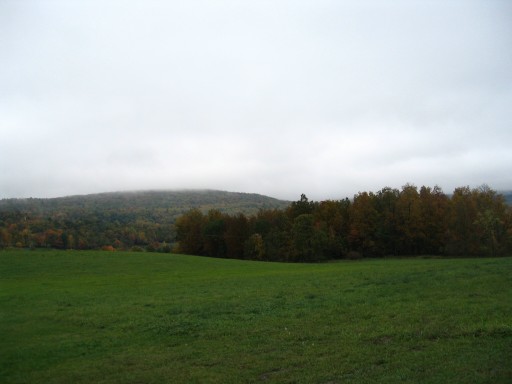
No particular relevance, but just outside of South Berne
we happened on this wonderful view. Smack dab in the middle of this
field with the mountain behind it, and the changing trees, was this fairly
new, large house. I took pictures of each side of the house, but
managed to not get a picture of the house. The pictures don't really
do justice to the color.
OK, so now we arrived in South Berne, Albany County, New
York. This location has particular relevance to me, because Michael
Decker lived in South Berne (listed here in each census from 1830 to 1860),
and his widow Elizabeth (Bovee) Decker is listed here in the 1865 New York
state census, and she appears on the plat map for South Berne, as shown at
the Berne History
website. Samuel Decker, my great, great, grandfather was born
here.
According to the 1866 map, Mrs. Decker
lived on Watertrough road, right near where it curves slightly to the left.
There are two homesteads shown in this area, that of J. Carl and Mrs.
Decker. The pictures show the current homes in this area, with the
first home being farther up the road and surrounded by an old stone wall
(this home is shown in three pictures). The next picture (the mailbox
by the road) is just before and down the hill from the new log-style home,
and is probably the site of the 1866 Decker home. Just before these
both of these homes is the entrance to the cemetery, South Berne Rural
Cemetery.
Just before the cemetery is an empty field.
The last picture shows the intersection of Watertrough & Church roads, with
the picture taken from Watertrough Rd.
An interesting thing happened while on our way to
getting lost. Figuring that we were pretty much done with genealogy,
family history, cemeteries, and such for the day, we were heading north
toward (eventually) the toll road. A little baffled when I reached
Schoharie, New York, I wasn't sure which way I really wanted to to (I wasn't
expecting to have to turn).
Anyway, at this
intersection (which I took a picture of due to the color of the trees on the
side of the mountain), we spotted a covered bridge off to our left.
This seemed to be a nice place to stop & stretch, and figure out our best
move.
Walking across the bridge I spotted a cemetery
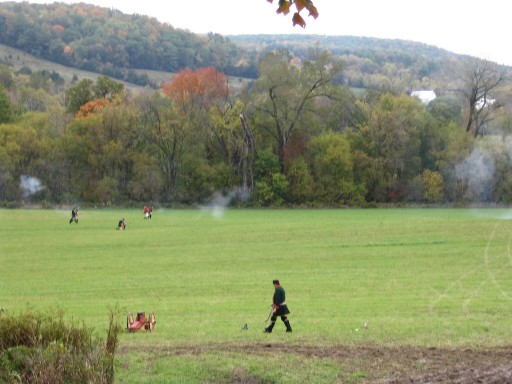
ahead, in the town of Schoharie, NY. Walking on ahead, we also
discovered that it happened to be the day (Old Stone Fort days) in which the
town does a Revolutionary War re-enactment - right across from the cemetery.
Browsing through the cemetery (quite large) in
search of Decker graves (why not - we're here kinda thing) wasn't producing
much. With all the people around I decided (with a little persuasion)
to go inside the museum and ask. Being short staffed, I was initially
rebuffed in my attempt, but given the small nature of my request, I was
rewarded. The staff at the museum in Schoharie, New York was very
gracious in the midst of all that was going on, and I am very appreciative.
I soon found out that there weren't any Deckers buried in this cemetery, but
there were in other cemeteries in the county. With time constraints &
the casual nature of our drive, we didn't really have time to go searching
for even more cemeteries. But then it was suggested that we might be
interested in "The Decker Barn." Yes, this did sound interesting.
See below.
Finally, I just happened to look down at the leaves
in the cemetery, and thought they provided some interesting color, so I took
a picture. I liked it so well, I made it into a
wallpaper, also.
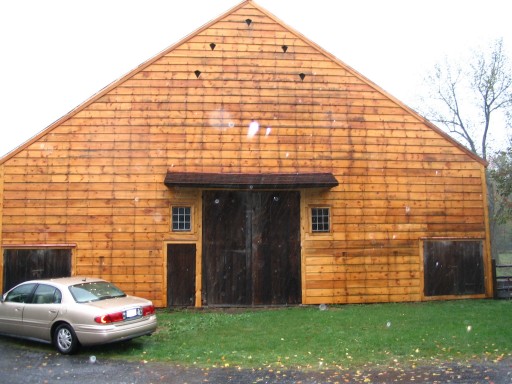
OK... So... The Decker Barn? The unusual
feature of the barn, we were promised back in Schoharie, was that the barn
was built so that it straddled the road. One of the workers in the
museum remembered walking by it on her way to school every day when she was
younger, although she didn't think you could still drive through it.
She gave us very good directions, and the meandering through the countryside
continued. Instead of continuing to head northwest to reach the
interstate, we headed to the southwest. This further insured that we'd
spend even MORE TIME driving. But it was worth it.
At the south end of the Town of Blenheim, in
Schoharie County, New York, we found the barn as described. Near the
intersection of Starheim (formerly Decker) Rd. & Curtis Rd.
I was given some basic information on the Decker
families that lived in the area, but need to do more research. George
Decker, son of Tunis Decker, is mentioned in the area history. It
discusses him living just south of the property on which the Decker barn
sits. From what I gather, the barn was built approximately in the
mid-1800s, but again I have to look into this more.
The pictures clearly show the road going through
the barn, but beyond the barn it is nothing more than a two-track trail,
which would be impassible. With the many "No Trespassing" signs
posted, rain, and lack of time, we ended up pressing on after taking
pictures of The Decker Barn.
So... upon leaving here, we had lots of ground to make up.
After pretty much a full day of driving, and much driving through the
mountains north, we finally reached the toll road - less than an hour west
of Albany (about two hours from where we started the day). My goal of
reaching Buffalo by the end of the day was pretty much shot. After
following highway 20 for a while, we finally turned north on highway 12
(major construction, oops!) due to the necessity of finding someplace to
eat. This was accomplished in Utica. We finally crashed for the
night at the Comfort Inn just outside of Syracuse.
Day 5 - October 10, 2005 (Returning Home)
One final stop on the way home that had to do with
family history was to visit Newfane, Niagara County, New York.
Although I had been here before, My mom and aunt hadn't. This really
had as much to do with showing my aunt where her grandfather was born &
lived than anything else.
We stopped and
visited the cemetery again. While Samuel Decker and his wife Mary
Lovina Barber are believed to be buried here, again there are no records,
and no headstones to prove this. Her parents are buried here, and
there are several missing & broken stones. It was interesting to focus
the digital camera on the stones that are there, it seemed to help to bring
the worn writing into focus a little bit.
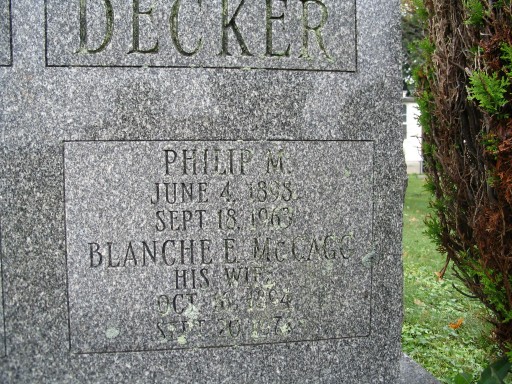
Probably more pictures here than were necessary,
but since my last visit here as in January 2002, this time I was able to
take some pictures without interference from the snow.
I took extra pictures here so that I could focus in
on the stones very closely, taking top & bottom pictures as necessary.
What can I say, but it's Hard Rock Cafe. We
stopped on our way through Niagara Falls. As much for the shot glass
(for me) as for the food, but I do have an All Access Card, and try to stop
at any & all Hard Rock Cafes that I come across in order to buy the shot
glass.
This one has items of particular
fondness for me, as I consider Stevie Nicks to be my favorite singer.
On display is the Fleetwood Mac platinum album for "Rumors", and the dress
that Stevie wore during the filming of the "Edge of Seventeen" tour and
"Talk to Me" video (1982).
And for proof, I have pictures of my mom (Nora
Decker) and my aunt (Jean [Decker] Hanke).
And they both enjoyed their bowl of chili.
For the record.
Finally, no trip to Niagara Falls is complete without...
well... actually seeing the falls. Although it was cloudy & somewhat
misty during our stop, the visit down to the falls on the American side was
still worthwhile, and very relaxing.
After I
noticed the Hard Rock Cafe on the Canadian side of the falls, just across
the river, I decided that from here too, I also needed a shot glass.
This was much more of an adventure than the simple meal and souvenir that
was had on the American side. Perhaps because it was Columbus Day, and
many schools in New York didn't have class that day, but there were MANY
tourists in Niagara Falls, Ontario, that day. Way too many.
Needless to say, once I had my (much more expensive) shot glass, we couldn't
wait to head out of town and head for home.
Overall, we drove about 1700 miles on this trip.
We saw a lot of Decker history, some scenic drives through the mountains, a
lot of trees changing color, and many other sites along the way. We
ate a lot of food, met some great cousins (who've been at this longer than I
have), and thoroughly enjoyed ourselves.




![[ Yahoo! Maps ]](http://us.i1.yimg.com/us.yimg.com/i/us/mp/gr/mplogo.gif)






 Click
to see full size.
Click
to see full size.